International company establishment
Incorporating abroad is heavier than it was. We coordinate it cleanly.
Beneficial-ownership disclosure. Economic substance. Local-content rules. Bank KYC running months behind incorporation. We coordinate entity formation and the surrounding compliance load through vetted in-country partners across 72 markets.






What's Changed Since 2021
Setting up a foreign entity is materially heavier than it was
What was once a filings exercise now sits inside a layered compliance environment: beneficial-ownership registers (UK PSC, EU UBO directives, the US Corporate Transparency Act), economic-substance requirements, sanctions screening on any new incorporation, and bank KYC that runs on its own slower clock. Local-content rules in sectors like energy, mining and telecoms add further structure, and tax residency, transfer pricing and domestic-tax exposure now have to be settled alongside entity choice, not after. None of this is a reason not to set up abroad, just a reason to coordinate it properly.
What We Coordinate
A Five-Step Coordination Service, End to End
We coordinate the incorporation and the surrounding compliance load through vetted in-country partners. One scope of work, one UK-based point of contact, one editorial standard across jurisdictions.
Jurisdiction comparison
A short comparative brief covering entity options, substance requirements, tax treatment, banking friction, and cost to establish and maintain. Built so the decision can be taken at board level, not buried in a legal memo.
Entity type advice
We work alongside your legal and tax advisors to turn the comparison into the right entity choice (subsidiary, branch, representative office, joint-venture vehicle or SPV) for your commercial and tax position. We coordinate those advisors, not replace them.
Incorporation coordination
Filings, apostille, notarisation, local-agent appointments and statutory registrations in the chosen jurisdiction. One project plan, one status report, one point of escalation if something stalls.
Registered office, nominee and substance
Registered office services, resident director or nominee arrangements where permitted, and evidence of local substance where the jurisdiction requires it. We will not act in a way that creates beneficial-ownership or sanctions risk.
Tax registration and banking introductions
Tax registrations (VAT, payroll, corporate income tax, sector-specific) and introductions to banks we have worked with in the market. Bank KYC runs on its own timeline, and we flag this at scoping.

5
Continents covered through a dedicated local network
1000+
Discrete engagements completed for global clients




















72
International markets reached via in-country partners

What Coordination Includes
A typical International Company Establishment engagement produces:
Every deliverable is built to be used: the jurisdiction memo is a board paper, the compliance map a living reference, the incorporation plan a document your local advisors can act on directly.
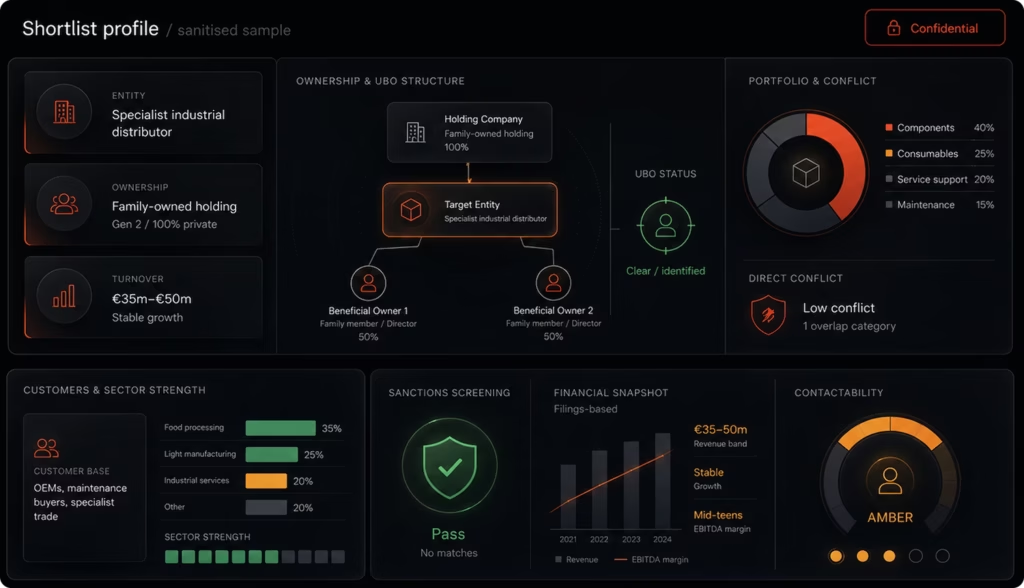
- Jurisdiction comparison memo: entity options, substance rules, tax treatment and running cost
- Recommended entity type and structure, agreed with your legal and tax advisors
- Incorporation coordination: filings, apostille, notarisation and local-agent appointments
- Compliance map: beneficial-ownership disclosure, substance rules, sanctions screening, local-content rules
- Director and shareholder identity verification, sequenced ahead of incorporation
- Registered office, nominee and substance arrangements where the jurisdiction requires them
- Tax registration and banking introductions, with KYC support to account opening
Jurisdictions We Work In
Where We Regularly Coordinate Entity Establishment
We regularly incorporate or coordinate entity establishment across the regions below. The list names the markets where we do this work most often, not the full 72-market footprint.
(1)
- UK & Ireland
United Kingdom · Ireland
(2)
- Major EU economies
Germany · France · Netherlands · Spain · Italy · Poland · others on request
(3)
- North America
United States (federal / state-selected) · Canada
(4)
- Middle East
United Arab Emirates · Saudi Arabia · Qatar · Oman (free-zones and mainland)
(5)
- Asia
Singapore · Hong Kong · Malaysia · Vietnam · India · Indonesia · Thailand · Philippines · China · Japan · South Korea
(6)
- Africa
South Africa · Kenya · Egypt · Morocco · Nigeria · others on request
(7)
- Latin America
Mexico · Brazil · Chile · Colombia · others on request
If your target jurisdiction is not listed, ask us, as our 72-market footprint extends further than the shortlist above.
How we work
Six-Step Process
STEP 1/6
Scoping
Jurisdiction brief
Entity type decision
Incorporation & registrations
Banking & substance
Post-incorporation handover
6-8 Weeks
Entity live and compliant.
Working with us
Typical engagement shapes
Single-market setup
Multi-market rollout
Exploratory scoping
Single-market setup
One jurisdiction. Full incorporation and compliance coordination through a single vetted local partner.
Multi-market rollout
Several jurisdictions run in parallel, with UK-led oversight keeping entity choice, banking and compliance consistent across markets.
Exploratory scoping
A comparative brief on entity options, tax exposure and banking friction, used to decide where and how to set up before committing.
Pricing Indicators
How Engagements Are Priced
At a glance:
- Fixed fee for incorporation coordination, scoped per jurisdiction.
- Annual fee for registered office, nominee and substance services where used.
- Bank introduction and KYC support: scoped separately. We cannot guarantee account opening; that is the bank's decision.
- Multi-jurisdiction engagements: programme-managed from the UK hub, with a single scope of work and a single invoice route.
We will quote fixed fees wherever the scope allows it. Where a jurisdiction has genuinely unpredictable elements (regulator queries, bank KYC loops, sector-specific licensing) we quote a base fee plus clearly-defined variable elements, and flag them at scoping, not at invoice stage.

Related services
Where buyers go next
Answers to Common Questions
If you can’t find your answer, email us at enquiries@copernicus-consulting.com
General
Process
Support
When should a company consider establishing a local company overseas?
A local entity may be useful when a company needs to employ staff, invoice locally, contract with local customers, meet regulatory requirements, bid for tenders, satisfy distributors or demonstrate long-term market commitment.
Is company establishment always necessary for market entry?
No. Many companies can begin through distributors, agents, direct export, local representatives or strategic partners. Company establishment should be considered only where it supports the commercial case.
What are the risks of setting up too early?
Setting up too early can create unnecessary cost, tax obligations, administrative burden and management complexity before the market opportunity is proven.
What can Copernicus help with?
Copernicus can help assess whether local establishment is needed, compare practical options, identify local requirements, coordinate with local advisers and provide a staged route map.
Is this suitable for SMEs?
Yes. For SMEs, the key is to avoid overcomplication. We help assess whether a local entity is genuinely needed or whether a lower-risk route is more appropriate.
Can company establishment be part of a wider market entry plan?
Yes. Establishment often follows market research, distributor assessment, customer validation or partner search. It should be linked to a clear commercial rationale.
What outputs do clients receive?
Outputs may include an establishment options note, route map, local adviser requirements, key decisions, estimated steps and implementation priorities.
Can you help us understand local setup costs and timescales?
Yes. We can help gather indicative information on likely steps, documentation, timescales, professional support and practical dependencies.
Can you coordinate multiple countries at once?
Yes. Multi-market programmes, typically three to eight jurisdictions under one scope of work, are one of the most common reasons clients come to us. One UK point of contact, one programme-management layer, one editorial standard across markets.
Can Copernicus manage the process end to end?
We can coordinate the process and support the client through it, but local legal, tax, accounting and regulatory work will normally be undertaken by specialist advisers.
Do you replace our lawyers and accountants?
No. We coordinate alongside them. If you do not have local counsel or a local tax advisor in the target jurisdiction, we will introduce you to firms we have worked with, but the legal and tax opinions come from them, not from us.
Can you help with bank account opening?
Yes, introduction and KYC support. We will introduce you to banks we have worked with before in the market, and we will help you assemble the KYC pack to the standard the bank expects. We cannot guarantee account opening; the final decision is the bank’s.
Do you provide nominee director services?
Where permitted and appropriate. We will not act as, or arrange, nominee directors in jurisdictions or structures where doing so would create sanctions exposure or breach beneficial-ownership disclosure rules. If a nominee arrangement is not appropriate, we will say so.
Do you support employment or local staffing questions?
We can help identify the issues and connect clients with appropriate local employment, HR or payroll specialists where needed.
Do you act as a money-services business?
No. We do not hold or transmit client monies beyond standard service-provider escrow where a jurisdiction specifically requires it. Money movement is done through your banks, not through us.
Can you set up in sanctioned or restricted jurisdictions?
No. We do not operate in sanctioned markets, and we do not accept engagements for sanctioned parties. If a market moves onto a sanctions list mid-engagement, we withdraw.