Strategy & Turnaround
Stalled, stuck or reshaping?
We work it through at board level
A Copernicus principal works directly with your board and senior team to diagnose what is holding the business back, build a coherent strategy, and turn it into an implementation plan with real milestones. Where useful, non-executive-style support continues for 3–12 months after delivery.






Who This Is For
Three situations this engagement Is built for
Strategy & Turnaround is a senior advisory engagement. It is not a deck-production exercise, and it is not an analyst-army consultancy. A Copernicus principal works directly with your board and senior team on one of three situations:
Companies that have stagnated
Flat profits for two years or more. Strategy has drifted. The senior team no longer agrees on where growth comes from. A board-level reset is overdue.
Turnaround situations
Loss-making, cash-constrained, or facing a specific shock: a market collapse, the loss of a major customer, a regulatory change, a supply-chain rupture. Decisions need to be made quickly but well.
Companies reshaping for international growth
A strategy review concludes that international expansion is the answer. The work then routes into CIC’s broader service set, with the same principal staying involved on the ongoing-support contract.
5
Continents covered through a dedicated local network
1000+
Discrete engagements completed for global clients



















72
International markets reached via in-country partners

The Two-Phase Engagement
How the Engagement Is Structured
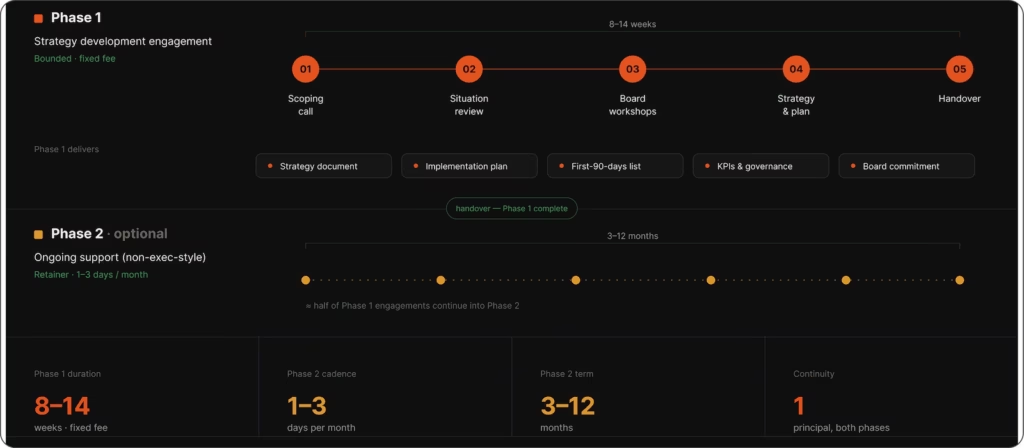
Two phases, the second optional. Phase 1 is a bounded, fixed-fee Strategy Development Engagement: situation review, board and senior-team workshops, a written strategy, and an implementation plan with milestones, typically over 8–14 weeks.
Phase 2 is an optional non-executive-style retainer, typically 1–3 days per month on a fixed 3–12 month term, supporting execution, keeping the plan honest and providing external challenge at board level. The same Copernicus principal leads both phases: no handover to associates, no rotating cast.
- Phase 1: Strategy Development Engagement
- Phase 2: Optional Ongoing Support (non-executive-style)
- Scoping call: The Copernicus principal meets the owner, chair or CEO to understand the situation, confirm the right level of engagement, and agree scope and fee before work starts.
- What it is: A fixed-term retainer of typically 1–3 days per month, over 3–12 months, led by the same principal who ran Phase 1. Explicitly optional; roughly half of Phase 1 engagements continue into it.
- Situation review: A structured diagnosis of financials, market position, operations, team, customers and competition. Typically 3–4 weeks, run directly by the principal using your data and targeted interviews.
- What it looks like in practice: Management meetings, progress reviews, challenge to the senior team, and a sounding board for the owner or CEO. The principal steps in as situations arise: a hire, a renegotiation, a pivot.
- Strategy & implementation plan: A written strategy with a sequenced plan: milestones, owners, dependencies, a first-90-days action list and KPIs. Built to be used, not parked on a shelf.
- Why clients choose it: Execution is where most plans fail. The retainer keeps the plan on track and the senior team honest against it. The cheapest challenge a mid-market board can buy.
- Handover session: A final board session to commit to the plan, assign ownership of each workstream and set the governance rhythm for execution. Phase 1 is then formally complete.
- How it's structured: Contracts of 3, 6, 9 or 12 months with 3-month break clauses. Days per month are fixed and do not roll over. Extensions in 3-month increments by agreement.
Indicative Fees
What the engagement typically costs
(1)
Phase 1: Strategy Development Engagement (fixed fee)
| Company size | Indicative fixed fee | Typical duration |
|---|---|---|
| Small: <£5m revenue, <50 staff | £25k — £45k | 8–10 weeks |
| Mid-market: £5m — £50m revenue | £45k — £90k | 10–12 weeks |
| Larger mid-market: £50m — £250m revenue | £90k — £175k | 12–14 weeks |
(2)
Phase 2: Ongoing Support (optional monthly retainer)
| Company size | Indicative fixed fee | Typical duration |
|---|---|---|
| Small: <£5m revenue, <50 staff | £3,500 – £6,000 | 1 – 2 days |
| Mid-market: £5m — £50m revenue | £6,000 – £12,000 | 1 – 3 days |
| Larger mid-market: £50m — £250m revenue | £10,000 – £20,000 | 2 – 3 days |
* Contract length: 3, 6, 9 or 12 months. Break clauses at 3-month intervals.
** These are indicative ranges. A scoping call will give you a firm fee for your situation. We do not quote fees without understanding the brief.
Who Delivers
Each engagement is led by a Copernicus principal
Direct principal leadership
(01)
Every engagement is led personally by a Copernicus principal. A single principal owns the engagement end-to-end, not a rotating cast of associates.
Seniority Profile
(02)
Typically 25+ years of commercial leadership experience in mid-market businesses. Experience spans executive and non-executive board roles, P&L leadership, buy-and-build programmes, international expansion, and turnaround situations.
Board-level credibility
(03)
Principals are used to sitting across a board table with owners, chairs, CEOs, CFOs and non-execs. The conversations are peer-level, not consultant-to-client.
Continuity into Phase 2
(04)
If the engagement continues into Phase 2 ongoing support, the same principal stays on. Nothing is handed down or handed off.
How we work
From Scoping Call to Optional Ongoing Support
STEP 1/6
Scoping call
Situation review
Board workshops
Strategy & plan
Handover
Optional ongoing support
8–14 weeks (Phase 1)
Strategy agreed, with a plan to deliver it.
Working with us
Typical engagement shapes
Strategy development
Turnaround diagnostic
Ongoing advisory
Strategy development
A Copernicus principal working with the board: diagnosis, workshops, and a written strategy with an implementation plan. Fixed fee.
Turnaround diagnostic
A focused review of a loss-making or cash-constrained business, setting out what has to change and in what order.
Ongoing advisory
Non-executive-style support once the strategy is set, typically one to three days a month from the same principal.
Related services
Where buyers go next
Answers to Common Questions
If you can’t find your answer, email us at enquiries@copernicus-consulting.com
General
Process
Support
What type of strategy work does Copernicus support?
Copernicus supports practical strategy reviews, market repositioning, international growth planning, business development strategy, turnaround planning and performance improvement.
When should a company seek strategy or turnaround support?
Support may be useful when growth has stalled, market entry has underperformed, costs are misaligned, overseas activity lacks focus, management needs external challenge or a business requires a practical recovery plan.
What makes Copernicus different from a large strategy consultancy?
Copernicus is practical and commercially grounded. We focus on usable recommendations, realistic actions and implementation priorities rather than large theoretical frameworks.
Do you take equity?
No. Fee-for-service only. Taking equity would compromise the independence of advice, particularly in turnaround situations. This is a position, not a negotiation.
Are you a licensed insolvency practitioner?
No. We are not, and we do not pretend to be. Where a situation needs formal restructuring or administration, we say so clearly at scoping and introduce you to specialists we trust.
Do you provide financial restructuring advice?
No. We focus on commercial strategy, market positioning, operational priorities and business improvement. Legal, insolvency, tax or regulated financial advice should come from appropriate specialists.
Is this suitable for SMEs?
Yes. SMEs often need clear, practical strategy support that is proportionate to their resources and commercial reality.
How does Copernicus approach a strategy review?
We start by understanding performance, market position, customers, competition, costs, management objectives and the practical constraints facing the business.
How do you work with our existing management team?
Alongside them, at board and exec level. We are not replacing anyone. The principal acts as a senior external voice, bringing structure to the diagnosis, challenge to the workshops, and discipline to the plan. The team that executes is your team.
Can you support international turnaround situations?
Yes. International underperformance may involve weak distributor selection, poor market fit, unclear positioning, inadequate local support, pricing issues or insufficient market understanding. Copernicus can help diagnose these issues.
Can strategy work be linked to market research?
Yes. Strong strategy is often research-led. We can combine market intelligence, competitor review, customer insight and internal assessment to inform the strategy.
How quickly can a review be completed?
A focused strategic review can often be completed within a relatively short timeframe, depending on the availability of information and management input. Larger or multi-market reviews require more time.
What happens if Phase 1 concludes the business needs something we don't do?
We say so clearly in the handover and help you engage the right specialist: a licensed turnaround practitioner, a corporate finance advisor, an HR consultancy, legal counsel. We would rather make a clean introduction than take fees for work that isn’t ours.
What outputs are delivered?
Typical outputs include a strategic review, diagnosis, options analysis, action plan, priorities, risks, milestones and implementation recommendations.
Can you help with implementation?
Yes. Copernicus can support management through implementation reviews, progress tracking, external challenge and refinement of the action plan.
Can the Phase 2 retainer start before Phase 1 completes?
Occasionally, where a situation is acute and the board needs ongoing support from day one. This is agreed upfront at scoping, not mid-engagement.
Can Phase 2 be extended?
Yes. Extensions are handled in 3-month increments by mutual agreement. Most Phase 2 engagements that extend do so because the execution plan is longer than the original contract, not because the plan is failing.
Can you help prepare a board-level action plan?
Yes. Outputs can be structured for board discussion, investor review, management planning or operational implementation.